Design-led luxury is not just about beautiful rooms or fashionable furniture—it’s a philosophy of hospitality where every curve, texture, and sightline is intentional. In these stays, architecture becomes a storyteller, interiors become a language, and the guest experience is shaped by the way light moves across stone, the way sound is softened by linen, and the way a lobby’s spatial rhythm makes you slow down without being told. Exploring Hospitality Through Design-Led Luxury Concepts is an invitation into properties that treat design as the main service: not decoration, but direction—guiding your mood, your pace, and your sense of arrival.
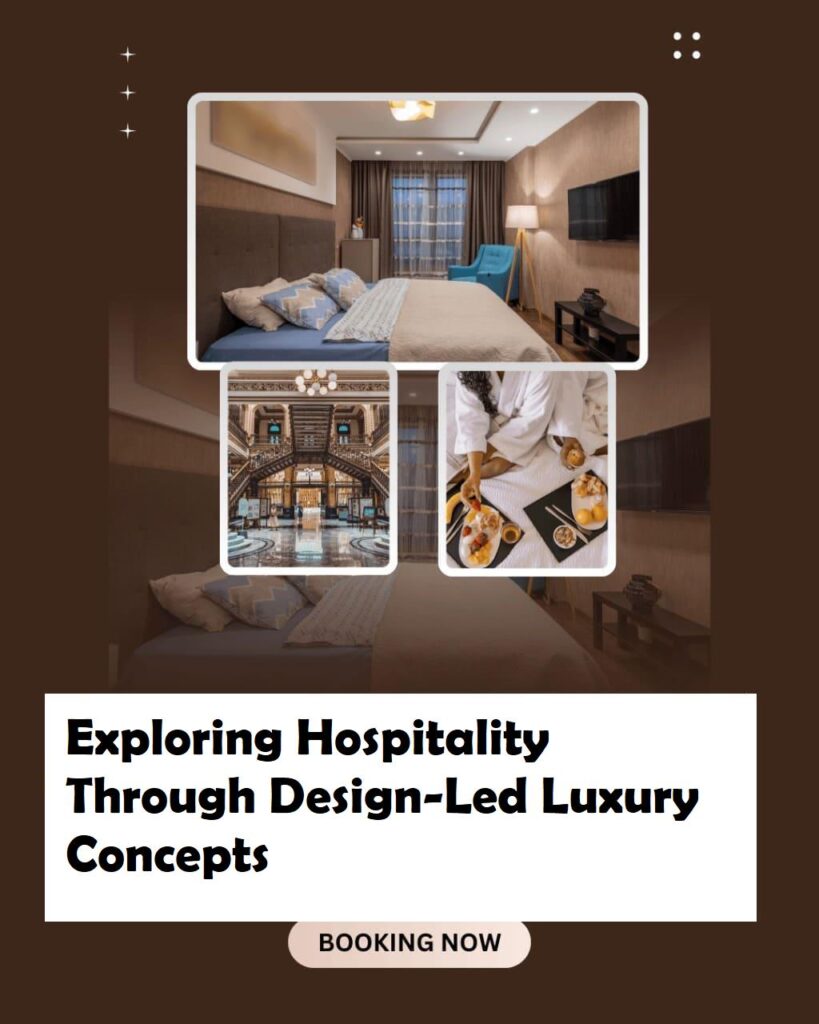
1) The Gallery-Living Lobby Concept
Some hotels feel like you’ve stepped into a curated exhibition—only the art is not distant or untouchable. The lobby becomes a living gallery where sculptural seating, museum-grade lighting, and statement installations set the tone immediately. Here, luxury is not announced; it’s composed. You’ll notice how the staff move with quiet choreography, how the check-in desk is integrated like a design element, and how even the scent feels “designed” rather than perfumed. This concept delivers a refined kind of energy: you feel elevated simply by being in the space, as if your travel wardrobe and your mindset both upgraded at the door.
2) The Material-First Minimalism Concept
Minimalism, in the right hands, is never cold—it’s confident. Design-led hotels built around material-first minimalism use fewer objects, but richer ones: veined marble, hand-finished timber, brushed metals, raw linen, and textured plaster walls that look like they were shaped by light itself. The luxury here is in restraint and craftsmanship. Rooms feel spacious because they refuse clutter. Silence feels thicker, softer. Even the simplest ritual—pouring tea, adjusting the curtains, stepping barefoot onto warm wood—becomes a sensory experience. It’s the kind of place where you stop checking your phone, not because you’re trying to be mindful, but because the room has already done that work for you.
3) The Indoor–Outdoor Continuum Concept
Some properties don’t separate the hotel from its landscape—they stitch the two together. Design-led luxury here is defined by transitions: retractable walls, floating terraces, sunken lounges, gardens that drift into corridors, and pools positioned like mirrors to the sky. You don’t “go outside” as much as you flow outward. This concept is ideal for guests who crave calm without isolation—where open air becomes part of your suite’s personality. Morning light enters gently, evening breezes become natural air-conditioning, and even the shadows feel like a curated element of the architecture.
4) The Lighting-as-Architecture Concept
In truly design-forward hotels, lighting is not a feature—it is structure. Hidden LEDs trace the edges of stone, warm lamps mimic candlelight, and ceiling halos create a soft, cinematic mood that makes every space feel flattering and intimate. The experience is deeply emotional: you feel protected, centered, and quietly energized at the same time. This concept often creates the most memorable nights—where a corridor feels like a runway, a bar feels like a private members’ salon, and your suite turns into a sanctuary the moment the sun goes down. Luxury becomes a carefully tuned atmosphere, adjusted as smoothly as a dimmer switch.
5) The Cultural Craft Revival Concept
Design-led luxury reaches its peak when it respects place. In this concept, hotels collaborate with local artisans to turn heritage into modern beauty: handwoven textiles reimagined as wall panels, ceramics used as sculptural accents, and traditional patterns scaled into contemporary geometry. The result is authenticity without cliché. Guests don’t just “visit” a destination—they inhabit its creative identity. Every object has a story, and the hotel feels like a bridge between old craftsmanship and modern comfort. It’s luxury with meaning, and the kind of stay that leaves you inspired long after check-out.
Q&A: Design-Led Luxury, Made Practical
Q1: What makes a hotel truly “design-led” instead of just stylish?
A design-led hotel builds the guest journey around design decisions—layout, acoustics, light, materials, flow, and emotional tone. Style is what you see; design-led luxury is what you feel.
Q2: Which hotels are known for strong design identities?
Consider places like Aman Tokyo (calm minimalism), The Silo Hotel, Cape Town (industrial art-forward drama), Hotel Il Pellicano, Tuscany (timeless editorial design), and The Upper House, Hong Kong (quiet, modern serenity). Each offers a distinctive design narrative.
Q3: Are design-led hotels comfortable for long stays, or more “for photos”?
The best ones are built for living. Look for thoughtful ergonomics: excellent bedding, smart storage, soundproofing, lighting scenes, and lounge spaces that invite you to stay in—not just post and leave.
Q4: How do I pick the right concept for my travel style?
If you want calm and clarity, choose material-first minimalism. If you want romance and mood, choose lighting-as-architecture. If you want nature as therapy, choose indoor–outdoor continuum. If you want cultural depth, choose craft revival.
Conclusion
Exploring Hospitality Through Design-Led Luxury Concepts celebrates a new standard of indulgence—one that doesn’t rely on excess, but on intention. These hotels offer exclusivity not only through privacy and service, but through the feeling of being inside a perfectly imagined world. When design becomes the main form of hospitality, every detail supports you: the quiet, the comfort, the beauty, and the subtle confidence of spaces made to elevate your senses. This is luxury that lingers—because it’s built into the architecture of your memory.