In a world where travel often mirrors the pace of daily life, a new philosophy of hospitality is quietly taking shape—one that treats calm not as a decorative layer, but as essential infrastructure. These hotels are not designed to impress through spectacle or visual excess. Instead, they are built on an underlying system of emotional balance, where silence is intentional, space is respected, and every design decision supports a sense of ease. Calm becomes structural, engineered into the experience from arrival to departure, shaping how guests move, rest, and reconnect with themselves.
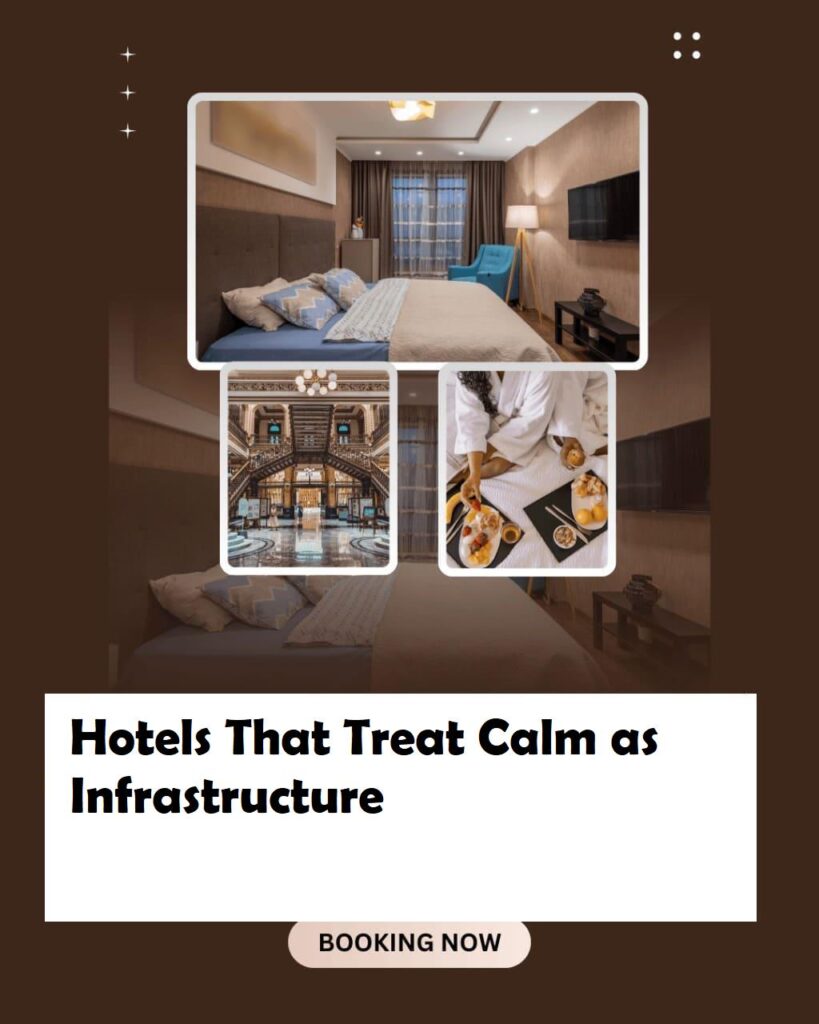
Calm as a Foundational Design Principle
In these environments, tranquility begins long before a guest reaches their room. Arrival sequences are deliberately slowed, often guided by natural pathways, muted lighting, and unobtrusive staff interactions. Architecture favors flow over formality, allowing guests to transition gently from the outside world into an atmosphere of control and clarity. Corridors are wider, acoustics are softened, and transitions between spaces feel seamless rather than abrupt.
This approach treats calm much like electricity or water—something reliable, always present, and never intrusive. Guests may not consciously notice it at first, but they feel its effects immediately. The absence of noise, crowding, and visual clutter creates an emotional baseline that allows rest to occur naturally.
Interiors That Regulate Emotion
Inside, these hotels prioritize materials that age gracefully and textures that absorb sound. Stone, wood, linen, and clay are chosen not for trend value but for their grounding qualities. Color palettes lean toward muted earth tones, reinforcing stability and comfort. Furniture is arranged to encourage openness and privacy at the same time, offering personal space without isolation.
Lighting plays a crucial role. Rather than dramatic contrasts, illumination is layered and adaptive, following natural circadian rhythms. Mornings feel gently awakening, while evenings invite reflection and rest. The result is an interior environment that subtly regulates emotion, helping guests slow their thoughts without effort.
Service Designed to Reduce Cognitive Load
Calm-as-infrastructure extends into service philosophy. Staff interactions are purposeful but minimal, designed to anticipate needs rather than create dependency. Information is delivered clearly and sparingly, reducing decision fatigue. Technology, when present, remains invisible—supporting convenience without demanding attention.
Guests are never rushed, interrupted, or overwhelmed with options. Dining, wellness, and leisure offerings are curated rather than expansive, ensuring that choice enhances comfort instead of complicating it. This restraint allows guests to feel supported without feeling managed.
Landscapes That Complete the System
Outdoor spaces are treated as extensions of the interior calm. Gardens, courtyards, and water features are arranged to guide movement slowly, often encouraging walking, sitting, or quiet observation. Views are framed intentionally, drawing the eye toward nature instead of activity.
Whether located in urban centers or remote settings, these hotels create protective buffers from their surroundings. Soundscapes are controlled, vistas are uncluttered, and nature is used as a stabilizing force—reinforcing the sense that calm is not situational, but constant.
Q&A: Additional Hotels Embracing Calm as Infrastructure
Q: Are there notable hotels known for this approach to calm?
A: Yes. Aman Tokyo integrates silence and spatial discipline into a dense urban environment, while Alila Villas Uluwatu uses open-air architecture and ocean-facing geometry to create natural emotional balance.
Q: Which hotels focus on sensory regulation rather than luxury display?
A: The Chedi Andermatt emphasizes material weight, acoustics, and spatial rhythm to promote deep rest, while Six Senses Douro Valley integrates landscape, wellness, and restrained design to maintain a constant sense of ease.
Q: Are these hotels suitable for long stays or work retreats?
A: Absolutely. Properties such as COMO Shambhala Estate are intentionally designed for extended stays, offering environments where mental clarity and physical restoration can coexist with productivity.
Conclusion: Where Calm Becomes a Structural Advantage
Hotels that treat calm as infrastructure offer more than comfort—they provide a framework for restoration. By embedding tranquility into architecture, service, and spatial planning, these destinations allow guests to experience luxury without effort or excess. Calm is no longer a temporary feeling or a marketing promise; it becomes a dependable system that supports presence, focus, and renewal.
For travelers seeking experiences that feel quietly powerful and deeply intentional, these hotels redefine what it means to truly rest. Here, calm is not an accessory—it is the foundation upon which every memorable moment is built.